
Regular assessments and mindful adjustments are crucial for maintaining safe driving as parents age. Early conversations, professional evaluations, and planning transportation alternatives help preserve independence and safety.

Aging parent driving safety is the ongoing process of evaluating, supporting, and managing an older adult's ability to drive as physical, cognitive, and sensory abilities gradually change. Drivers aged 70 and older have significantly higher crash death rates per 1,000 crashes compared to drivers aged 35–54. That statistic matters because it means the risk is real, but it does not mean every older driver is unsafe. The goal is not to take away the keys at the first sign of aging. The goal is to understand what safe driving for seniors actually looks like, recognize when something has shifted, and know how to have the conversations that matter most.
The clearest early signals are often physical and behavioral. According to health professionals at the University of Utah, common warning signs include repeated near-misses, visible damage to the car, failure to signal, difficulty making left turns, and leaning heavily on a passenger for directions or reassurance. These behaviors point to a decline in the split-second processing that driving demands.
Beyond the obvious dents and scrapes, watch for subtler patterns:
Any one of these signs on its own may not be cause for alarm. A pattern of two or three, especially if they are new, is worth taking seriously. Cognitive changes that affect driving, including early memory loss, can sometimes show up behind the wheel before they are obvious in daily conversation. Helping-mom has a helpful resource on signs of dementia that can help you connect what you are seeing on the road to what may be happening more broadly.
Safe driving for seniors is not just about avoiding bad habits. It is about building smarter habits that compensate for the real changes aging brings. Reaction time slows. Night vision dims. Neck stiffness makes shoulder checks harder. The good news is that compensatory driving strategies can meaningfully reduce risk when applied consistently.
Here are practical adjustments that work:
| Strategy | Why It Helps |
|---|---|
| Drive 10 a.m. to 2 p.m. | Avoids rush hour and low-light conditions |
| 6-second following distance in poor weather | Compensates for slower braking response |
| Eliminate unprotected left turns | Reduces exposure to high-speed cross traffic |
| Avoid night driving | Addresses glare sensitivity and reduced contrast vision |
| Annual vision and hearing exams | Catches correctable deficits before they affect safety |
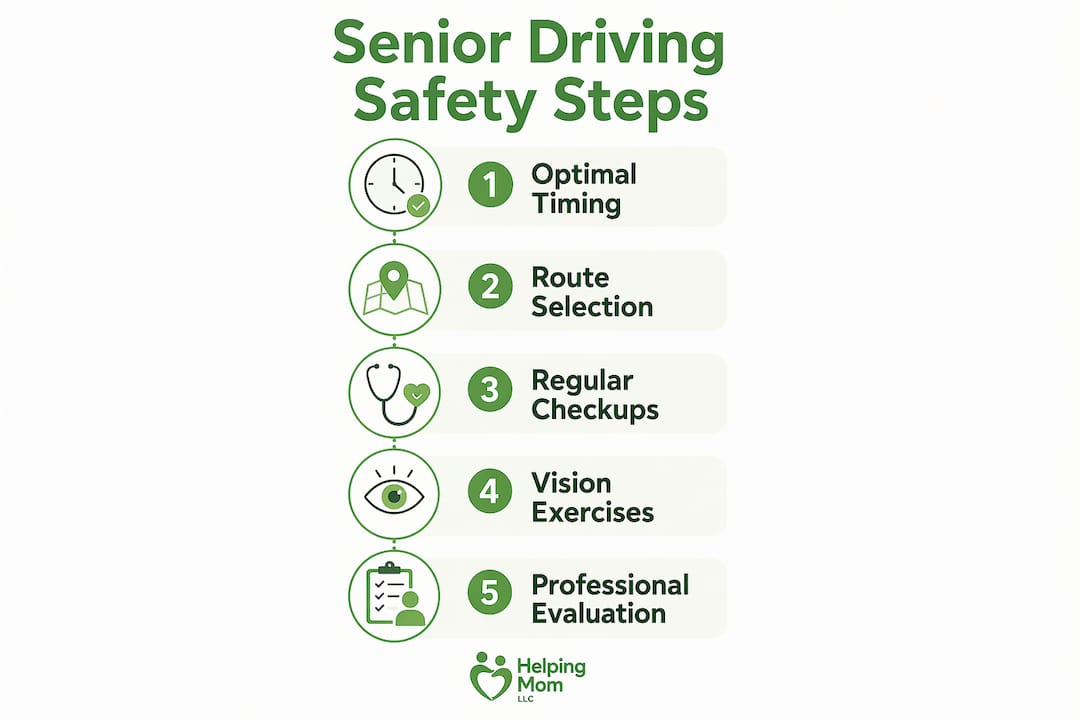
One thing worth understanding: self-regulation alone is unreliable. Many older drivers promise to avoid night driving or highways, and they mean it sincerely. But declining insight is part of aging too. A parent may not realize how much their abilities have changed. Self-imposed limits are a good start, but they work best when paired with outside input from a professional or a trusted family member.

Assessing parent driving skills is one of the most emotionally loaded tasks an adult child faces. You love your parent. You do not want to undermine their confidence or their independence. And yet you have a nagging sense that something has shifted. That tension is real, and you are not alone in feeling it.
The most objective tool available is a professional functional driving evaluation. These assessments, typically conducted by occupational therapists who specialize in driver rehabilitation, evaluate cognitive, sensory, and physical abilities as they relate to actual driving. They include both an in-clinic assessment and an on-road test. The result is a professional opinion, not a family argument.
This matters because physicians rarely perform detailed functional driving assessments. Relying only on a doctor's general sign-off can leave real safety questions unresolved. A functional evaluation fills that gap with specificity.
For families who want to start with their own observations, here is a structured approach:
"Families often delay these conversations until a crisis forces the issue. Starting early, calmly, and with facts rather than fear gives everyone more options and more time." — NPR, reporting on older drivers and adult children's hard choices
When it is time to talk, approach the conversation as a partner, not an authority. Phrases like "I noticed something that worried me and I want to understand it together" land very differently than "I think you should stop driving." Helping-mom's guide on talking to aging parents walks through this kind of conversation in detail. Some states also allow family members to request a driving re-evaluation through the DMV, which can take the pressure off the family dynamic entirely.
Reducing or stopping driving does not have to mean losing independence. The key is planning ahead, before a crisis forces the decision. Older adults who plan transportation alternatives early adjust to the transition far more smoothly than those who face it suddenly.
Practical options to explore together include:
Scheduled regularly rather than requested in moments of need
Including bus and light rail systems in many metro areas
Low-cost or free rides through local Area Agencies on Aging
Uber and Lyft — many seniors use them comfortably with practice
Often run through churches, nonprofits, or senior centers
Eliminates many routine driving trips entirely
The emotional side of this transition deserves as much attention as the logistics. Driving represents freedom, adulthood, and self-sufficiency for most people who grew up in the United States. Losing it can feel like a significant loss of identity. Acknowledging that openly, rather than minimizing it, makes the conversation more honest and more productive. Helping-mom's guide on senior transportation options is a good starting point for mapping out what is available in your area.
Aging parent driving safety requires early observation, honest conversation, and a practical plan that protects both safety and dignity.
| Point | Details |
|---|---|
| Know the warning signs | Look for new dents, lane drifting, missed signals, and increased anxiety behind the wheel. |
| Use compensatory strategies | Mid-morning driving, longer following distances, and avoiding left turns reduce risk meaningfully. |
| Get a professional evaluation | Occupational therapist driving assessments provide objective findings that remove family conflict. |
| Start conversations early | Families who talk before a crisis have more options and less emotional fallout. |
| Plan transportation alternatives | Senior ride services, rideshare apps, and delivery options preserve independence after driving stops. |
I have talked with a lot of families who waited too long. Not because they did not care, but because they did not know how to start. There is a particular kind of guilt that comes with worrying about your parent's driving. You feel like you are being disloyal, or presumptuous, or like you are rushing something that is not ready to be rushed.
Here is what I have come to believe: the earlier you start paying attention, the more choices everyone has. A parent who hears "I want to make sure you stay safe and independent for as long as possible" at 72 responds very differently than one who hears it at 80 after a fender-bender. The first conversation feels like care. The second can feel like a verdict.
Bringing in a professional evaluator is one of the most compassionate things you can do. It takes the judgment out of your hands and puts it in the hands of someone with no emotional stake in the outcome. That is not a cop-out. That is good caregiving. The moral burden adult children carry when they delay these conversations is real, and it is heavier than the discomfort of starting them early.
Walking alongside your parent through this does not mean taking control. It means staying close enough to notice, caring enough to speak up, and being patient enough to do it more than once if needed.
— Mike
If driving safety has you thinking more broadly about how your parent is managing at home, Helping-mom has practical guides designed for exactly where you are right now. The home safety guide for seniors walks through the most common hazards room by room, with clear steps you can take without overwhelming your parent or yourself. For families thinking further ahead, the aging in place resource hub covers everything from mobility aids to home modifications to family planning conversations. These resources are built for adult children in their 40s and 60s who want to be proactive without being overbearing. You do not have to figure this out alone.
Driving safety is just one part of the journey. Explore our full range of caregiving guides, or reach out for personalized support.