Aging Solo Today
A Solo Ager's Guide
By Mike C., Founder of Aging Solo Today
If you have age-related macular degeneration and you're doing this alone, sunglasses aren't a fashion decision. They're protective gear. Right up there with a good handrail in the bathroom and a smoke alarm that actually works.
Here's the good news. This is a solved problem. Low-vision specialists have been recommending the same short list of features for decades, and the sunglasses that check every box are inexpensive, easy to order online, and easy to wear over your regular glasses.
I'll walk you through exactly what to look for, why each feature matters, and the three pairs I'd put in a cart first. In that order.
Macular degeneration makes the eye more sensitive to two things: bright light (glare) and blue light (the highest-energy part of the visible spectrum).
Without protection, everyday outdoor light gets uncomfortable. Sometimes painful. You start squinting, tearing up in the sun, avoiding walks you used to enjoy, and getting tired faster. The right sunglasses fix all of that, and they help protect whatever vision you have.
You don't need to memorize a spec sheet. Just check for these five things, in this order, before buying anything.
Non-negotiable. UV 400 means the lens blocks all ultraviolet light up to 400 nanometers. Any pair without this label goes back on the shelf, no matter how good they look or how cheap they are.
A dark lens without UV protection is actually worse than no sunglasses, because your pupil opens wider behind the dark lens and lets in more UV. Gas-station sunglasses without the UV 400 label are the classic offender.
Blue light in the 400 to 500 nanometer range carries the most energy of any visible wavelength, and research links it to retinal stress in AMD patients. The BrightFocus Foundation recommends choosing lenses that specifically filter blue light.
You don't need indoor blue-light computer glasses. Save your money there. What you want is outdoor sunglasses that filter both UV and blue light.
This is where most people get confused, so here's the plain-English version.
Amber or copper is best for daily wear. It increases contrast, filters the most blue light, and a lot of AMD patients say the world looks sharper through them. In community discussions with AMD patients, amber and copper come up over and over as the tints eye doctors recommended.
Gray is best for driving. It keeps traffic-light colors and brake lights true. Amber can shift those colors slightly, which matters at intersections.
The pragmatic move: buy both. Amber for walking, gardening, running errands. Gray polarized for the car.
Standard sunglasses leak light. Every ray that sneaks in from the top, sides, or below your regular glasses defeats the purpose of the dark lens.
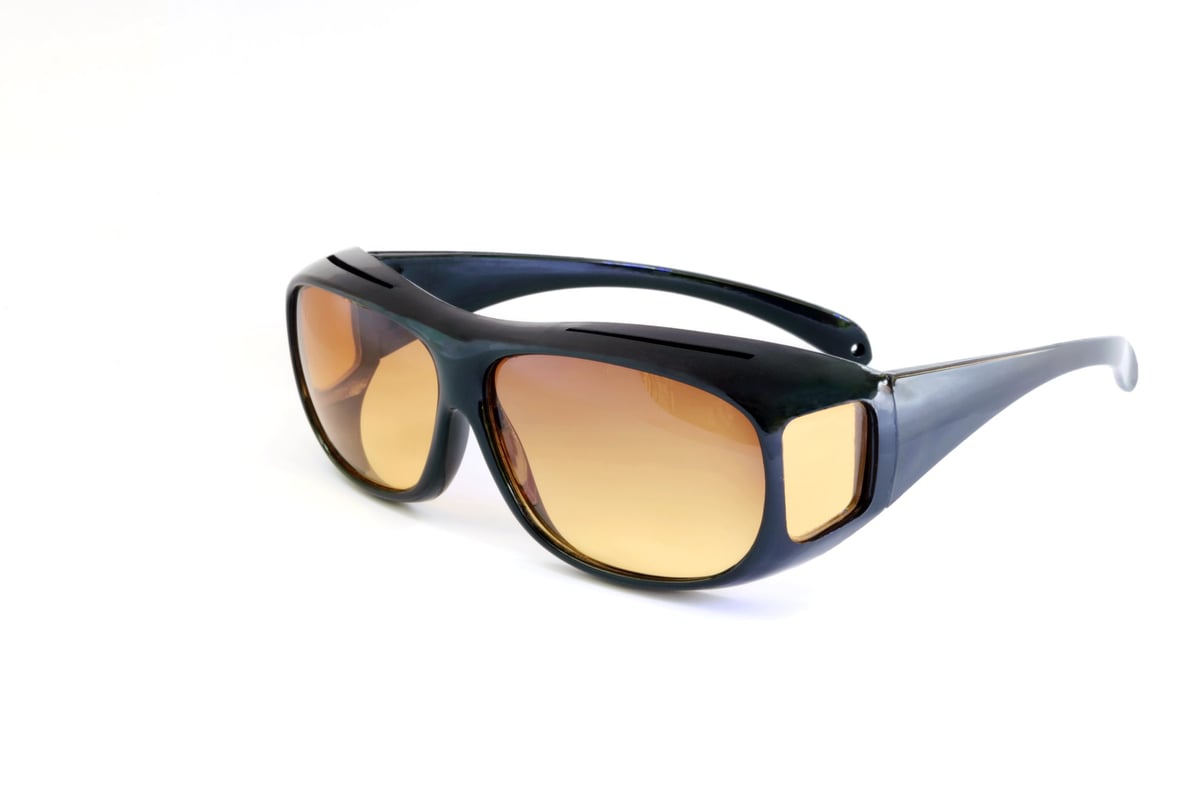
Fit-over frames are larger sunglasses designed to be worn over your prescription glasses. The ones built for low-vision use have brow shields across the top and side shields blocking peripheral light. This is what the American Macular Degeneration Foundation specifically recommends for people who wear glasses.
Fit-overs solve a practical problem too. You don't have to switch back and forth between reading glasses and prescription sunglasses. You keep your regular glasses on and slip the fit-overs on top when you head outside.
Polarization cuts painful glare from roads, car hoods, water, and shiny surfaces. Especially helpful if you still drive, or you spend time near water. Not every pair needs to be polarized — the darkest medical-grade lenses sometimes aren't — but for daily-wear amber and gray sunglasses, polarized is worth the small upcharge.
Ordered from clinic-grade down to a $20 backup pair.
The low-vision specialist's standard
NoIR is the brand most commonly dispensed by low-vision clinics. A PubMed study of 318 low-vision patients found that patients with dry macular degeneration consistently preferred NoIR amber and orange filters over other options.
The Number 01 Medium Amber fitover is a well-loved all-purpose choice. 15% visible light transmission, 100% UV, 98% blue-blocker, infrared protection, and side shields built in. Around $40 from Independent Living.
Around $33–$40 direct from NoIR Insight at noirinsight.com. Choose Fitover, then your size, then Amber. Multiple sizes available so you can match your own frame.
One thing to know. Research on colored filter preferences confirms comfort varies from person to person. If amber doesn't feel right, NoIR sells other tints such as orange, grey-green, and plum that also work for AMD. Trial and error is part of the process. Not a failure.
The everyday favorite
The most popular consumer fit-over brand, and the one recommended repeatedly in AMD support communities. The Polarized Amber hits the sweet spot. Amber tint for contrast, 100% polarization for glare, integrated brow and side shields, and a limited lifetime warranty. Around $50 from Cocoons.com.
Eight sizes. Use their Find My Size tool. 30-day money-back guarantee. Customer service at 800-834-2563.
Cocoons labels their amber lens as "not for driving." If you still drive, order their Polarized Gray version in the same size for the car. Two pairs total covers every situation.
The drugstore backup
Available at CVS and Walgreens, so you can walk in and try them on today. Under $20. Blocks 100% UV up to 521 nanometers, comes in amber, plum, yellow, and gray.
Not clinic-grade, but better than no sunglasses, and perfect as a backup pair for the car, a bridge pair while the good ones ship, or a spare in the purse for when the primary pair goes missing.
Before ordering anything online, measure your regular glasses in millimeters.
Width
Across the front of the frame, at the widest point
Height
From the top of the lens to the bottom, at the tallest point
Round up to the nearest whole millimeter. Both Cocoons and NoIR use these numbers to match you to a size. A fit-over that's too small pinches. Too big slides down the nose. This is the single most common reason fit-over sunglasses get returned.
If you just lost your sunglasses, or you've never had a proper pair, this is what I'd do.
Tonight
Measure your regular glasses. Order your primary pair from NoIR or Cocoons.
Tomorrow
Swing by Walgreens or CVS. Grab a $20 Solar Shield pair so you have protection right now, especially if you're outside during the day.
This week
The proper NoIR or Cocoons pair arrives. Wear them for a few days before deciding they're right.
Dark is not protective
A very dark lens with no UV rating is worse than nothing. Always check for the UV 400 label.
Skipping the label
If it doesn't say UV 400, don't buy it.
Buying too small
Fit-overs have to actually fit over. Measure first.
Amber for night driving
Save amber for daylight. Use gray polarized in the car.
Assuming clip-ons are enough
They don't block light from the sides. Wraparound fit-overs are what specialists recommend for AMD.
Here's the permission slip nobody gives you. You don't have to get this perfect the first time.
Research on low-vision filter preferences makes an important point. Even the "right" recommended tint doesn't work equally well for every person. Some AMD patients love amber. Others prefer copper or grey-green. Solo agers with AMD often try 2 or 3 tints before landing on the one that actually works.
That's not failure. That's how vision changes work.
If your first pair doesn't feel right, don't force it. Return them. Both Cocoons and NoIR make this easy. Then try another tint. The goal is a pair you'll actually wear. Comfortable, not so dark you feel blind indoors, and easy to slip on before heading out the door.
Start with a $20 drugstore bridge pair today. Something for right now. No pressure. Upgrade to the good pair once you know your tint. That's a plan you can execute on your own, on your own schedule.