
Discover essential elder planning tips for solo agers in 2026. Secure your independence and control your future with our comprehensive guide.

Solo ager reviewing elder planning documents at home
Elder planning involves organizing legal, medical, financial, housing, and caregiving arrangements to maintain independence. Starting early is essential, especially for solo agers, to build a comprehensive and effective safety net. Regular reassessment and proper documentation help ensure control and resources before a crisis occurs.
Elder planning is the process of organizing your legal, medical, financial, housing, and caregiving arrangements to maintain independence as you age. The industry term for this work is "elder care planning," and it covers everything from signing a power of attorney to deciding where you want to live at 85. For solo agers — adults without a spouse, partner, or nearby adult children — starting before a crisis expands your choices and keeps you in control. This guide walks you through each pillar so you can build a plan that works for your life, on your terms.
For solo agers, elder planning is not just about paperwork. It is about creating a support system before you need one. If there is no spouse, nearby child, or trusted family member ready to step in, every decision becomes more important. The goal is not to prepare for the worst. The goal is to stay independent, maintain control, and make sure your wishes are known.
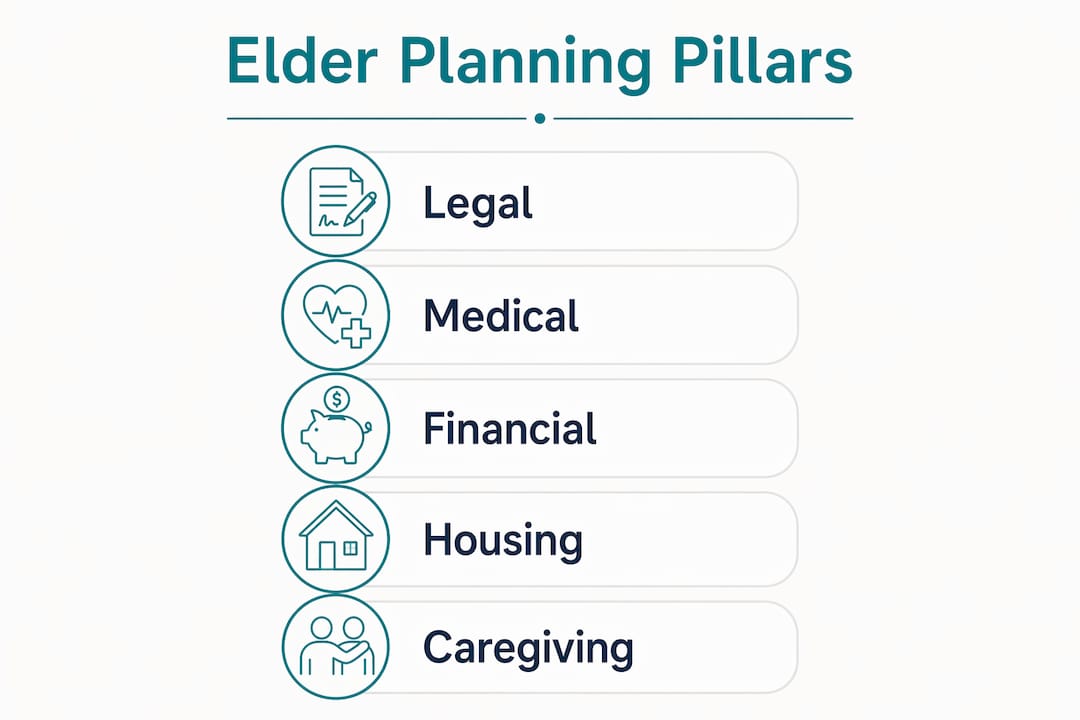
Elder planning is most effective when built around five pillars: legal, medical, financial, housing, and caregiving. Each pillar addresses a different area of your life, and gaps in any one of them can create real problems down the road. Think of it as building a real safety net, not just a single document tucked in a drawer.
The five pillars work together. A financial plan without legal authority documents leaves your money unprotected if you become incapacitated. A housing plan without a caregiving strategy leaves you without support when daily tasks get harder. Coordinated advisors, including an elder law attorney, a financial planner, and a care coordinator, make the whole system function as one.
Solo agers carry a specific kind of responsibility here. Without a built-in support person, you are the one who must set up every layer of this plan intentionally. Agingsolo exists to help you do exactly that, with practical tools and guides designed for people in your situation.
Legal documents are the foundation of any solid senior care planning strategy. Without them, no one has the legal authority to act on your behalf, even in an emergency. The two most critical documents are a durable power of attorney for finances and a durable power of attorney for healthcare.
These are separate documents. One assigns authority over your bank accounts, bills, and property. The other gives someone the right to make medical decisions for you. One document rarely covers both areas, and assuming otherwise is one of the most common planning mistakes families make.
You also need an advance directive or living will. This document records your medical wishes, covering decisions like resuscitation, ventilator use, and end-of-life care. It speaks for you when you cannot speak for yourself.
Pro Tip
Complete all legal documents while you are mentally capable. Courts cannot grant power of attorney to someone after incapacity has been established. Once that window closes, your family may face lengthy and expensive legal proceedings.
A few key points on legal documents:
Keep Everything Organized
Once these documents are completed, store copies in a dedicated Solo Aging Binder so they can be located quickly during an emergency. If you do not have one yet, read our guide on creating a Solo Aging Binder.
Setting up a healthcare proxy early is especially important for solo agers who do not have an obvious family member to step in.
Proactive medical planning means making your care preferences clear before a health crisis forces someone else to guess. The starting point is appointing a healthcare proxy, the person legally authorized to speak for you if you cannot communicate.
Beyond the proxy, a care coordinator or nurse plays a vital role in managing medications, scheduling appointments, and advocating for your needs across multiple providers. For solo agers, this kind of professional support fills the gap that a family caregiver might otherwise fill.
Home safety is a medical planning issue too. Reassessing home safety annually, or immediately after any change in mobility, vision, or medication, is the standard recommendation for preventing falls. Falls are the leading cause of injury-related hospitalization for adults over 65, which makes this reassessment one of the highest-value steps you can take.
Pro Tip
Ask your primary care doctor to review your medications at every annual visit specifically for fall risk. Some common medications, including blood pressure drugs and sleep aids, significantly increase fall risk when combined.
Here is what a solid medical plan includes:
Consider creating a one-page emergency summary that includes your current medications, allergies, medical conditions, emergency contacts, insurance information, and preferred hospital. Keep a printed copy in your home and another in your vehicle.
That last point matters more than most people realize. Medicare does not cover long-term custodial care, including help with bathing, dressing, or daily living activities. About 80% of assisted living costs are paid privately. Your medical plan must account for that gap.
Financial planning for seniors aging solo requires a larger buffer than standard retirement advice suggests. AARP recommends solo agers build an emergency savings fund covering 12–18 months of living expenses. That is two to three times the typical recommendation for couples or families. The reason is straightforward: you have no financial backup if an unexpected expense hits.

Medicare covers medically necessary services, hospital stays, and some home health care. It does not cover assisted living room and board, personal care aides, or most long-term custodial support. That gap can cost thousands of dollars per month.
Medicaid can cover long-term care costs, but qualifying requires careful advance planning. Federal law requires states to review all financial transactions from the 60 months before a Medicaid application. Transfers of assets made to qualify for Medicaid within that window trigger penalty periods that delay coverage.
| Funding Source | What It Covers | Key Limitation |
|---|---|---|
| Medicare | Hospital, medical, short-term rehab | No custodial or assisted living care |
| Medicaid | Long-term care for qualifying individuals | 5-year look-back on asset transfers |
| Long-term care insurance | Home care, assisted living, nursing home | Must purchase before health declines |
| Personal savings | Any care gap | Requires 12–18 months buffer for solo agers |
Pro Tip
If Medicaid planning is part of your strategy, start at least five years before you anticipate needing care. The look-back rules mean that last-minute asset transfers can delay your coverage by months or years.
The Agingsolo financial safety checklist is a practical starting point for adults living independently who want to organize their financial picture clearly.
Housing is where elder care planning becomes most personal. The goal for most solo agers is aging in place — staying in your own home as long as it is safe and practical. That goal requires active preparation, not passive hope.
A home safety assessment is the first step. Walk through your home and identify fall hazards, accessibility barriers, and emergency response gaps. Then update that assessment every year or after any health change. Annual reassessment is the standard because health and mobility can shift quickly.
Here is a numbered sequence for building your housing and caregiving plan:
Complete a home safety assessment
and address immediate hazards like loose rugs, poor lighting, and bathroom grab bars.
Research aging-in-place modifications
such as walk-in showers, stair lifts, and wider doorways before you need them.
Identify your support network
including neighbors, friends, and local services who can check in regularly.
Explore care coordination options
so you have a professional contact before a health event makes it urgent.
Plan your housing transition early
so that if a move becomes necessary, it is a choice rather than a crisis.
The Agingsolo aging in place guide covers home modifications and safety strategies in depth for solo agers who want to stay home longer.
For those who may eventually need to move, planning senior living transitions early gives you time to evaluate options without pressure. Rushed decisions made during a health crisis almost always result in worse outcomes and higher costs.
Many solo agers spend significant time planning finances and legal documents but overlook the people side of planning. Even a small support circle can dramatically improve your ability to age independently.
Someone who will answer the phone when it matters most.
Someone who can accompany you to appointments and ask the right questions.
A reliable option for getting to appointments when you cannot drive yourself.
A neighbor or nearby friend who has a spare key and can check on you.
Someone who will check on you during severe weather, power outages, or other emergencies.
These five people may be different individuals, or one trusted person can fill multiple roles.
Building your support circle is one of the most important steps you can take. Start the conversation today.
If you are building your elder planning documents from scratch, consider using the Aging Solo My Plan Notebook. It includes organized sections for medical information, emergency contacts, important documents, healthcare planning, finances, and notes — so everything is in one place when it is needed.
The most costly mistake in senior care planning is waiting. Planning before urgent needs arise expands your choices and reduces stress. Waiting until a diagnosis or a fall forces the issue means making major decisions under pressure, often with fewer options available.
Here are the mistakes that show up most often:
Confusing planning with placement.
Planning assembles your resources and documents your preferences. Placement chooses a specific care setting. Treating them as the same thing leads to rushed moves and poor fits.
Using one document for everything.
A single power of attorney rarely covers both healthcare and financial authority. Two separate documents are required to protect both areas.
Underestimating care costs.
Medicare does not pay for most long-term care. Assuming it does leaves a gap that can drain savings quickly.
Skipping periodic reassessment.
A plan built at 60 may not fit your needs at 75. Health, finances, and housing situations change, and your plan must change with them.
Working without a team.
Elder care planning requires coordinated legal, financial, and medical advisors. No single professional covers all five pillars.
"The best time to build your plan is before you need it. The second best time is right now."
Solo agers who document their personal wishes early give themselves and their support network a clear roadmap. That clarity is one of the most generous things you can do for yourself.
Effective elder planning requires legal, medical, financial, housing, and caregiving strategies built before a crisis, not during one.
| Point | Details |
|---|---|
| Start with legal documents | Complete separate powers of attorney for healthcare and finances while you are mentally capable. |
| Build a larger financial buffer | Solo agers need 12–18 months of emergency savings, not the standard 3–6 months. |
| Know what Medicare excludes | Medicare does not cover custodial care; plan for private costs or long-term care insurance. |
| Reassess home safety annually | Update your home safety assessment every year or after any change in health or mobility. |
| Plan placement separately from planning | Assemble your resources first, then evaluate care settings when you are ready, not when you are rushed. |
| Start planning before a crisis | Early planning expands your choices and reduces stress. Aging does not wait for us to feel ready. |
| Review documents regularly | Review legal documents every 3 to 5 years and after any major health, financial, or housing change. |
| Build both a paperwork plan and a people plan | Legal documents alone are not enough. You need trusted people in your corner too. |
| Know what Medicare and Medicaid cover | Understanding the limitations of each program prevents costly surprises down the road. |
| Keep everything organized in one place | Store important documents, contacts, and medical information in an accessible, single location. |
After years of working with older adults, caregivers, and families, I have noticed that most people do not avoid planning because they are irresponsible. They avoid it because it feels overwhelming. The paperwork, the decisions, and the uncertainty can make it easy to postpone. Unfortunately, aging does not wait for us to feel ready.
I have seen this pattern repeat itself more times than I can count. Someone in their late 60s or early 70s finally sits down to think about elder care planning, and the first thing they say is, "I wish I had done this sooner." Not because they are in crisis, but because they can see how much easier the process would have been five years earlier.
The uncomfortable truth is that most people delay because planning feels like admitting something. It feels like acknowledging that things will change, that you will need help someday, that your independence has a timeline. But that framing gets it exactly backward. Planning is what protects your independence. The people who plan early are the ones who get to make real choices. The people who wait often find those choices have been made for them.
For solo agers specifically, the stakes are higher. You do not have a spouse who will step in automatically, or adult children nearby who will coordinate your care. That means every layer of your plan needs to be intentional and documented. Your healthcare proxy needs to know your wishes. Your financial records need to be organized. Your home needs to be assessed honestly.
The good news is that none of this has to happen all at once. Start with one document. Have one conversation. Take one step. The plan builds from there, and each piece you put in place gives you more confidence and more control. That is what Agingsolo is here to help you do.
— Mike
Founder, Agingsolo
Agingsolo is built for exactly this kind of planning. Whether you are just starting to think about your future or you are ready to work through the details, the resources here are practical, clear, and designed for solo agers.

You will find step-by-step guides on maintaining independence at home, checklists for legal and financial preparation, and tools for building the support network that makes independent aging sustainable. The life care planning guide is a strong next step if you want a structured framework for pulling all five pillars together.
You do not have to figure this out alone. Agingsolo is here to walk through it with you, one steady step at a time.
Quick answers to common elder planning questions
Continue your journey with these related articles from Agingsolo.