
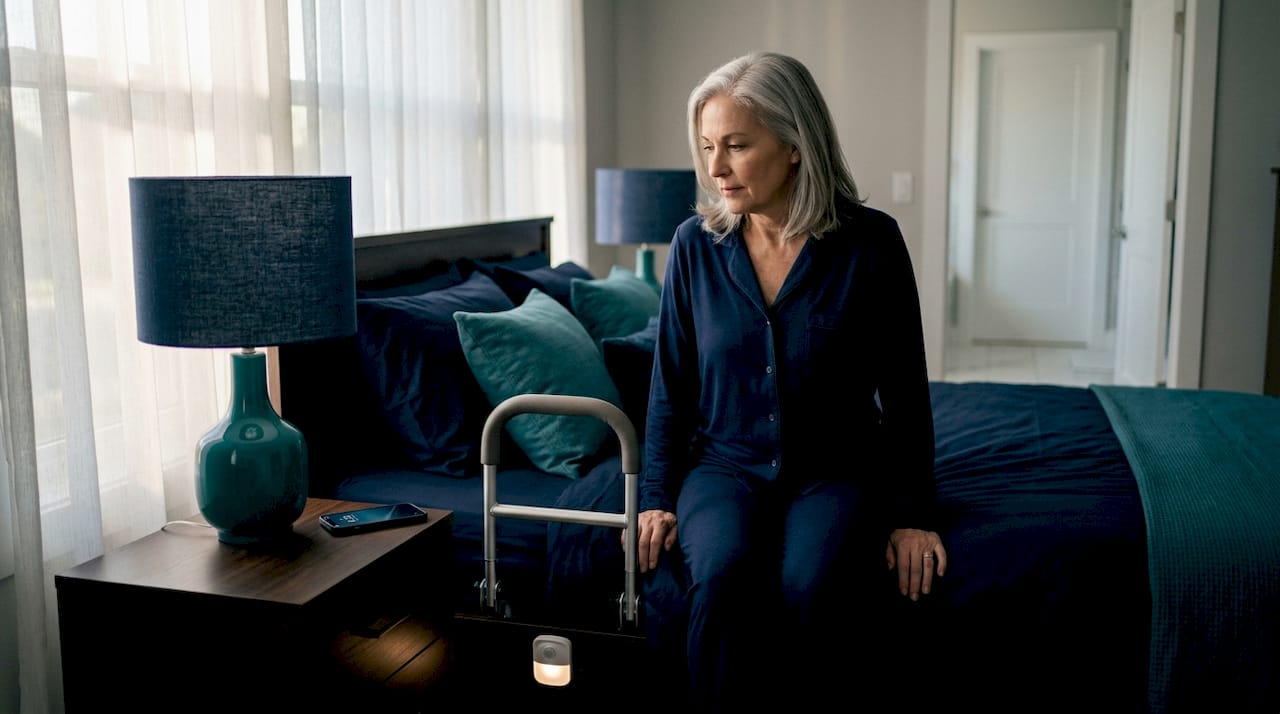
Featured Article
Discover essential tips in this guide on living alone sleep safety explained for adults 50+. Ensure your nights are safe and secure!
TL;DR:
Living alone sleep safety involves preparing your environment to prevent falls, fire, carbon monoxide poisoning, and intruders. Simple, affordable habits like installing motion-activated lights, using grip socks, and keeping your phone charged greatly reduce risks. Building consistent routines and testing alarms regularly ensure timely help and safer nights for adults over 50 living alone.
There is a unique quiet that comes with living alone. Most nights, that independence feels comfortable and familiar. But if something goes wrong at 2 a.m. — a fall, a fire alarm, or a sudden medical issue — there may be no one else in the home to help. That is why sleep safety deserves more attention than most solo agers give it.
Living alone sleep safety is the practice of preparing your bedroom and home environment to prevent nighttime falls, fire, carbon monoxide poisoning, and security threats before they happen. For adults 50 and older, this preparation is not optional. It is the difference between a minor incident and a serious one with no one nearby to help. The risks are real, the solutions are affordable, and the peace of mind that comes from a well-staged sleeping environment is worth every bit of effort. This guide covers the hazards, the fixes, and the habits that make solo sleep genuinely safe.
Motion-sensor lights, grip socks, and a bed rail eliminate the most common nighttime hazards for under $75.
Smoke alarms inside each bedroom and CO alarms outside each sleeping area are required by IRC 2024 and CPSC 2026 standards.
Keep it on your nightstand every night and treat a low battery as a safety issue, not just an inconvenience.
Fall detection devices summon help automatically, which matters most when you cannot call for help yourself.
Walking your bedroom in low light and testing devices monthly turns good intentions into reliable protection.
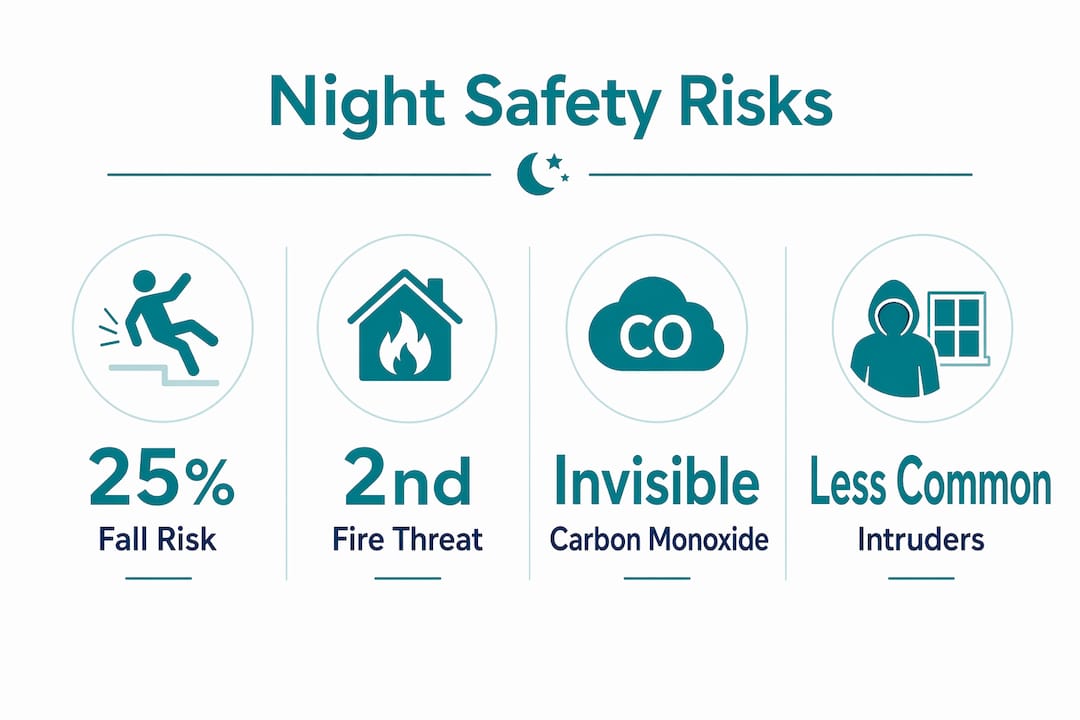
The four hazards that matter most for solo sleepers are falls, fire, carbon monoxide poisoning, and intruders. Each one carries a higher consequence when you live alone, because delayed help turns a manageable emergency into a serious one.
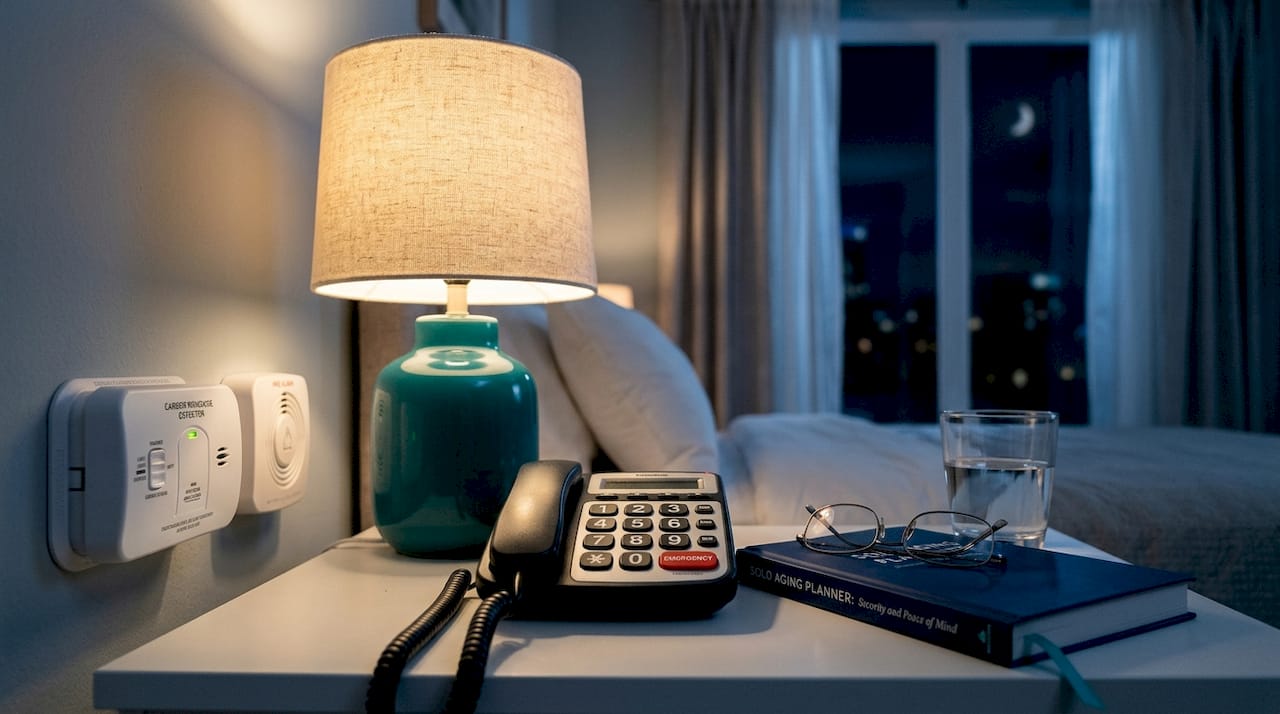
More than one in four older adults falls each year, and nighttime is when the risk peaks. Low light, sleep disorientation, and the urgency of a bathroom trip combine to create the most dangerous few steps in your home. The path between your bed and your bathroom is where most of these falls happen. That single stretch of floor deserves more attention than almost any other part of your home.
Fire is the second major threat. Sleep inertia, the groggy state you wake up in, slows your reaction time significantly. Interconnected alarms compensate for that delay by sounding throughout the home the moment one detector triggers. Without them, a fire in the kitchen may not wake you in a back bedroom until it is too late.
Carbon monoxide is invisible and odorless, which makes it uniquely dangerous. It does not announce itself. CO alarm placement outside each sleeping area, audible with doors closed, is required by IRC 2024 because CO gas spreads differently than smoke. Many solo adults have smoke alarms but no CO detectors. That gap is a serious oversight.
Security threats round out the list. Intruders are less statistically common than falls or fire, but the psychological weight of sleeping alone in a home with no one to call out to is real. Simple, low-cost tools address this without turning your home into a fortress. For a complete overview of staying safe as a solo ager, see our guide on how to live alone safely after 50.
Four simple changes can dramatically reduce the risk of nighttime falls while making it easier to move safely around your home. Here is how to implement each one.
Place one at the base of your bed and one at the bathroom doorway. Plug-in models cost $10 to $20 and activate the moment you swing your legs over the side of the bed. You never reach for a switch in the dark again.
A sturdy assist rail attached to the bed frame gives you something solid to grip when standing. Models run $25 to $45 and reduce the wobble that causes most bed-to-floor falls.
Put them on before your feet touch the floor. Grip socks cost $10 to $15 and address the slippery floor problem that causes most falls in the first 5 to 10 steps after standing.
Phone, glasses, water bottle, and any medication should be within arm's reach without leaning. Leaning is how falls start. This change costs nothing.
Beyond these four steps, keep the floor path to your bathroom completely clear. No rugs without non-slip backing, no cords crossing the walkway, no shoes left out. The goal is a path you could walk safely half-asleep, because sometimes that is exactly what you are doing.
Pro Tip: The hours between midnight and 4 a.m. carry the highest fall risk. If you take a sleep aid or any medication that causes dizziness, sit on the edge of your bed for 30 seconds before standing. That pause lets your blood pressure stabilize and your eyes adjust.
| Bedroom change | Approximate cost | Primary benefit |
|---|---|---|
| Motion-sensor night lights | $10–$20 | Automatic lighting on movement |
| Bed handle rail | $25–$45 | Stable grip when standing |
| Non-slip grip socks | $10–$15 | Traction on smooth floors |
| Nightstand reorganization | $0 | Reduces reaching and leaning |
The 2026 CPSC guidelines and IRC 2024 codes set clear requirements that many homeowners have not caught up with. Knowing the rules helps you verify your own setup is actually compliant, not just close enough.
Smoke alarms must be installed inside each sleeping room, outside each sleeping area, and on every story of the home. That means a single hallway alarm does not satisfy the requirement. You need one inside your bedroom as well. Wireless interconnection is accepted, and sealed 10-year battery units are now required in new construction. If your alarms are older than 10 years, replace them regardless of whether they still beep when tested.
CO alarms follow a different placement logic. Carbon monoxide is roughly the same density as air, so it distributes evenly through a room rather than rising like smoke. The IRC 2024 standard requires CO alarms outside each sleeping area, placed so they are audible inside bedrooms with doors closed. Every level of the home and any attached garage also requires coverage.
CPSC 2026 guidance recommends battery backup on every alarm and monthly testing. If an alarm sounds, the instruction is clear: exit immediately and call 911 from outside. Combination smoke and CO units can satisfy both requirements in a single device, but placement still needs to meet both standards. When in doubt, place the combination unit inside the bedroom for smoke coverage and add a dedicated CO alarm outside the bedroom door.
Pro Tip: Test every alarm on the first of each month. Set a recurring phone reminder. It takes two minutes and it is the single most reliable maintenance habit you can build.
Falls and fires are not the only threats that surface after dark. Medications you take during the day can quietly increase your nighttime risk in ways that are easy to overlook.
Sleep medications and nighttime disorientation
Common sleep aids can leave you groggy or disoriented if you wake up during the night. That fog makes falls far more likely on the walk to the bathroom. If you use a sleep aid, talk with your doctor about the lowest effective dose and whether non-medication alternatives might work for you.
Blood pressure medications and dizziness
Some blood pressure medications can cause a sudden drop in blood pressure when you stand up — especially at night. This orthostatic hypotension is a leading cause of falls in older adults. The 30-second sit-on-the-edge-of-the-bed rule is especially important if you take these medications.
Dehydration amplifies medication side effects
Mild dehydration is common overnight, and it can intensify dizziness, confusion, and weakness caused by medications. Keeping a water bottle on your nightstand serves two purposes: it keeps you hydrated and eliminates the need for a late-night trip to the kitchen.
Managing multiple medications safely is a skill that becomes more important when you live alone. For a complete guide on medication safety, including how to organize prescriptions, track side effects, and communicate with your healthcare providers, see our full article on how to manage medications safely when living alone after 50.
Security for solo sleepers does not require an expensive monitored system. A few targeted tools and habits cover the most likely scenarios.
Keep your phone charged and within arm's reach.
A phone at 12% battery at 2 a.m. is not a safety tool. Charge it on your nightstand every night. A charged phone within arm's reach is your fastest path to 911.
Use a door stop alarm.
These wedge-shaped devices cost around $12, slide under any door, and trigger a loud alarm if the door is pushed open. They require no installation and no Wi-Fi.
Consider pepper spray.
A canister on your nightstand costs roughly $10 and gives you a non-lethal option if someone does enter your space. Keep it where you can find it without turning on a light.
Use smart lighting schedules to simulate occupancy.
Lights that turn on and off at varied times signal that someone is home and active. This deters opportunistic intruders without any ongoing effort from you.
Maintain strong lock codes.
Change your keypad or smart lock code whenever a contractor, caregiver, or service person has had access. Stale codes are a quiet security risk that most people never think about.
For a broader look at home safety practices that support independent living, Agingsolo has a dedicated guide worth bookmarking.
Pro Tip: Before bed, do a 60-second walk-through. Front door locked, back door locked, windows on the ground floor latched. This habit takes less than a minute and removes the 2 a.m. mental loop of "did I lock the door?"
Speed of response is the variable that separates a survivable emergency from a fatal one when you live alone. The goal is to reduce the time between an incident and outside help arriving.
Wearable fall detection devices with 24/7 automatic monitoring can summon help even if you are unconscious. Some models include two-way voice, GPS location, and emergency dispatch within seconds of detecting a fall. This is the single most impactful technology investment for solo sleepers.
This point appears in the security section too, because it applies to every emergency type. Falls, fire, CO events, and intruders all require the same first action: call for help.
This sounds unusual, but it is critical. Relying solely on alarms may fail if you cannot respond effectively when groggy. Walk your bedroom in dim light and confirm you can reach your phone, find the door, and operate your alarm devices without full alertness.
A wearable device, a charged phone, and interconnected alarms together create redundancy. If one fails, another catches the emergency. No single device is 100% reliable.
Devices that have not been tested are devices you cannot trust. Build testing into the same monthly routine as alarm testing. Confirm your wearable connects, your phone charges fully, and your alarms sound.
For more on emergency call technology designed for solo agers, Agingsolo covers the current options in plain language.
Living alone sleep safety is one of those topics where the gap between knowing and doing is surprisingly wide. Most people I talk to have thought about it. Far fewer have actually staged their bedroom, tested their alarms, or put a charged phone on the nightstand consistently.
The falls piece is what I find most underestimated. People think of falls as something that happens to someone else, or something that happens during the day. The reality is that the midnight bathroom trip is one of the riskiest moments in a solo ager's day. A $15 pair of grip socks and a $15 motion-sensor light genuinely change that equation. The cost is trivial. The protection is real.
What I have also noticed is that the people who feel most secure sleeping alone are not the ones with the most expensive systems. They are the ones who have built small, consistent habits. The nightly door check. The phone on the nightstand. The monthly alarm test. These habits cost nothing and they compound over time into a genuinely safer home.
The goal is not to eliminate all risk. That is not possible. The goal is to reduce the most likely risks with the least friction, so that safety becomes part of your routine rather than a project you keep meaning to start. You deserve to sleep well. A little preparation makes that possible.
Independence and preparation work best together. A few simple changes tonight can help you sleep more confidently tomorrow.
— Michael Crawford
Sleeping safely when you live alone takes more than one good article. It takes a real plan, and that is exactly what Agingsolo is built to help you create.
Agingsolo offers practical guides, checklists, and tools designed specifically for solo agers who want to stay independent without pretending the risks do not exist. If you are new to the concept of planning for a solo future, aging alone: what every solo ager needs to know is a great place to start. From maintaining independence at home to building a full home safety and daily living strategy, the resources are grounded in real-world scenarios for adults 50 and older. If you are ready to move from thinking about safety to actually building it into your daily life, Agingsolo is a good place to start.
Want an easy way to review your nighttime safety setup? Download the Aging Solo Sleep Safety Checklist and walk through your bedroom, alarms, lighting, and emergency readiness in less than 10 minutes.
Download the ChecklistLiving alone sleep safety refers to the practice of preparing your sleeping environment to prevent nighttime falls, fire, carbon monoxide exposure, and security threats. It combines environmental changes, alarm compliance, and emergency readiness habits specific to solo dwellers.
More than one in four older adults falls each year, with nighttime trips between the bed and bathroom representing the highest-risk moments. Motion-sensor lights and grip socks are the most cost-effective prevention tools.
IRC 2024 requires CO alarms outside each sleeping area on every level of the home, placed so they are audible inside bedrooms with doors closed. Attached garages also require coverage.
A charged phone within arm's reach is the single most critical tool, giving you immediate access to 911 for any emergency. A door stop alarm costing around $12 adds a low-cost layer of intrusion detection without any installation.
Yes. Wearable fall detection devices with 24/7 automatic monitoring can summon emergency help even if the wearer is unconscious, with some models providing GPS location and two-way voice to dispatchers within seconds.
A flashlight within reach provides backup lighting during power outages and can help you move safely if alarms activate during the night.