
Many people assume that aging alone automatically means being at risk, isolated, or one bad fall away from a crisis. That assumption is understandable. But it is also worth questioning. Research increasingly shows that what protects us as we age is not simply who lives in the house. It is the strength and reliability of the people around us. Solo agers who approach their later years with a thoughtful plan can not only manage well but genuinely thrive. This guide will walk you through what solo aging really means, what the research says about risk and resilience, and how to build a safety net that actually holds.
Being a solo ager means living without nearby family support, but strong networks can make all the difference.
Your social network's diversity and reliability have a greater impact on well-being than simply living alone.
Proactively mapping your safety net and preparing documentation protects your independence and security.
Intentional solo aging is not just possible but can lead to higher satisfaction and safety when done thoughtfully.
If any of these resonate with you, you are not alone. Many solo agers do not realize they fit the definition until someone names it clearly.
When you fill out medical forms, you leave the emergency contact blank or write the name of someone who lives far away.
You drive yourself to procedures, sit through appointments solo, and manage follow-up care without someone else in the room.
If you were admitted to the hospital tomorrow, there is no one who would automatically be there to ask questions, take notes, or make decisions on your behalf.
Home repairs, finances, appointments, grocery runs, and planning for the future are all on your plate with no shared load.
You enjoy meaningful friendships, but there has not been an explicit conversation about who would do what if you needed help.
Recognizing these signs is not a reason to worry. It is a reason to act. The sooner you see where the gaps are, the sooner you can fill them.
Having positioned solo aging as more nuanced than many people realize, let's clarify exactly who this article is for and what solo aging truly means.
The term has a specific meaning, even if it sounds simple. "Solo aging" refers to older adults commonly age 50 and above who live alone and lack traditional family support such as a spouse, partner, or living adult children nearby. That last part matters. Many solo agers are deeply connected people. They simply do not have a built-in emergency contact living under the same roof. It is not just about your household. It is about who is realistically in your corner when things get hard.
You might meet the definition of a solo ager if you:
Here is something important to understand. Living alone and being a solo ager are not the same thing. You could share a home with a roommate and still be a solo ager if that person is not part of your support system. Conversely, you might live alone but have neighbors, close friends, or community connections who genuinely show up for you. Solo aging is really about your support structure, not your address.
This distinction matters because it points to what you can actually change. You may not be able to change whether your children live nearby. But you can build, strengthen, and maintain the network around you.
"Solo aging is not a fixed condition. It is a situation that responds directly to how thoughtfully and proactively you prepare."
For a broader introduction to these concepts, the Solo Aging 101 guide at Aging Solo is a good place to start. It covers the landscape of what solo aging involves and helps you see where you currently stand.
The solo ager population is growing steadily. More Americans are living alone in their 50s, 60s, and beyond than in any previous generation. For many people, solo aging is simply the reality of modern life. It reflects changing family structures, longer lifespans, geographic mobility, and more deliberate lifestyle choices. What it does mean is that planning for solo aging has become a skill worth developing sooner rather than later.
Now that we've identified who solo agers are, let's look closer at why having a robust social network, not just cohabiting, plays a crucial role in well-being.
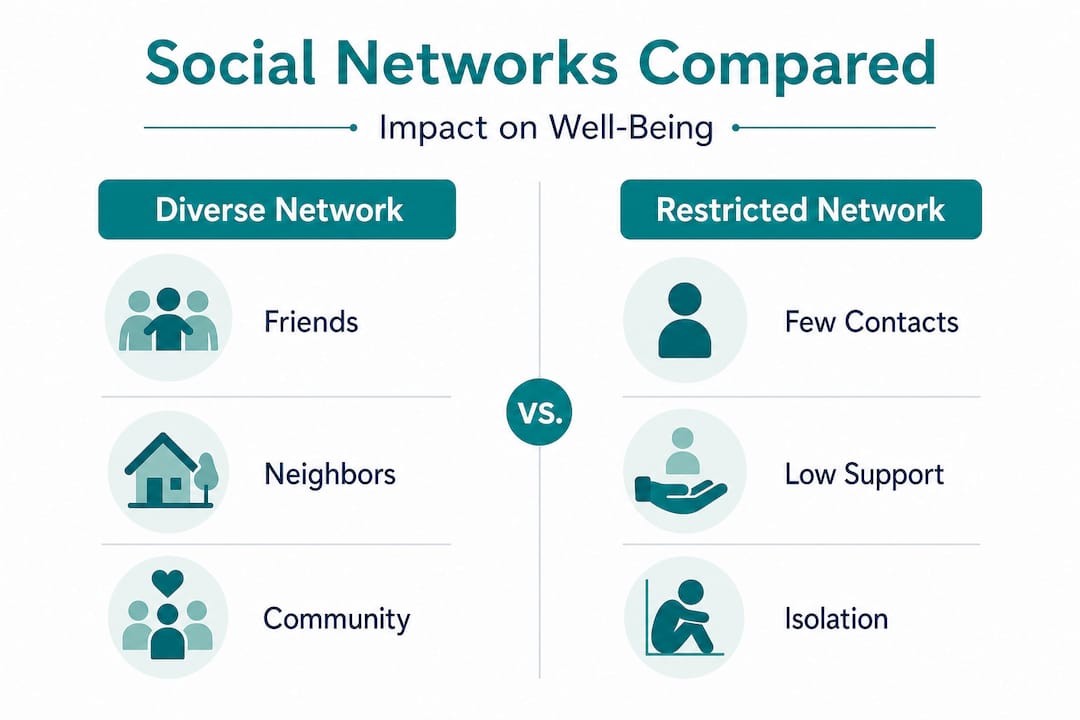
Here is a finding that surprises many people. Social network structure matters far more than whether you live alone. Researchers have identified four types of social networks among older adults who live by themselves. Understanding which category you are in right now can be genuinely eye-opening.
| Network type | Key characteristics | Well-being outcomes |
|---|---|---|
| Diverse | Mix of family, friends, neighbors, and community ties | Highest well-being, often better than people who live with others |
| Family-focused | Primary support comes from relatives | Moderate well-being, dependent on family availability |
| Friend-focused | Relies mainly on friendships | Moderate well-being, can be strong with consistent connection |
| Restricted | Few or no reliable social contacts | Highest vulnerability to loneliness and health decline |
The findings here are worth sitting with. Solo agers with diverse networks often report higher well-being than people who do not live alone. That is not a typo. Having varied and thoughtful connections, even without a spouse or children, can be more protective than simply sharing a roof with someone.
Those in the restricted category face the real risk. Not people who live alone. People who live alone and have very few meaningful connections. That is the combination that creates genuine vulnerability.
The benefits of social engagement for older adults are well documented. Regular social contact supports cognitive health, reduces the risk of depression, and even appears to lower rates of physical decline over time. Connection is not just emotionally comforting. It is physically protective.
Pro Tip:
Think of your social network as something that needs regular tending, like a garden. It does not stay healthy on its own. A monthly check-in with your loneliness checklist can help you catch gaps before they widen.
The good news is that network type is not permanent. You can shift from a restricted or family-focused network to a more diverse one through deliberate choices. That shift starts with building your support circle, which takes time but pays off steadily.
Understanding the importance of support networks, let's turn to what solo agers most often worry about and what data shows are the real obstacles to thriving alone.
If you have ever lain awake wondering what would happen if you got sick, or had a fall, or needed someone to drive you to an appointment, you are not alone in that worry. It is one of the most common concerns solo agers bring up. And it is worth separating the fear from the actual risk so you can plan more clearly.
The anxieties that come up most often include:
Some of these are emotional concerns. Some are logistical. Both matter. But they call for different responses.
On the practical side, the gap is real. Building a personalized safety net is central to solo aging planning, including who can help with tasks and decisions, along with legal, financial, and health preparations. Research suggests only about one in four solo agers reports having someone they can reliably count on for household help. That is a meaningful gap. But it is one that can be closed with planning.
Not having someone to call after a hard day, or feeling invisible during the holidays. That is real and worth addressing through community, connection, and honest conversations. Learn more about building your support circle.
Not having a healthcare proxy, not having someone who knows where your important documents are, or not having a plan for what happens if you cannot manage your home for a few weeks.
Knowing which gap is affecting you most helps you focus your energy. You do not have to solve everything at once. You just have to start somewhere.
That is something you can address directly, step by step, and the legal and financial basics section at Aging Solo is a strong place to start closing those gaps.
Once you recognize where vulnerabilities could arise, the next step is proactive preparation. Here's how you can start planning for your future today.
A personalized safety net is not built overnight, but it does not have to be complicated. It is built one relationship, one document, and one decision at a time.
Here is a practical sequence to follow:
Write down the names of people you could call in different situations: a health crisis, a home repair, a difficult decision. Be honest about who would actually show up.
Look at where your list is thin. Do you have someone who could advocate for you medically? Someone who knows your financial situation? A neighbor who would check in if they did not see you for a few days?
Ask people explicitly whether they are willing to take on a role in your plan. Do not assume. A conversation today prevents confusion later.
A healthcare proxy, durable power of attorney, and up-to-date will are foundational. These documents make sure your wishes are honored, even when you cannot speak for yourself. For detailed guidance, see our legal and financial basics.
Geriatric care managers, social workers, and elder law attorneys can fill gaps that friends and neighbors cannot. These are not admissions of failure. They are smart planning.
People move, relationships change, health shifts. Your plan should be a living document, not something you make once and forget.
| Planning area | Key action | Why it matters |
|---|---|---|
| Social support | Identify 3 to 5 people for different needs | Spreads the load, avoids over-reliance |
| Medical decisions | Designate a healthcare proxy | Ensures your wishes guide care |
| Legal documents | Complete power of attorney | Protects finances if you are incapacitated |
| Daily logistics | Arrange backup help for home needs | Reduces emergency scrambling |
| Professional support | Connect with a care manager if needed | Fills gaps when informal network is thin |
Pro Tip:
Keep a simple one-page document that lists your emergency contacts, doctors, medications, and legal document locations. Share it with two or three trusted people. It takes an hour to create and could make an enormous difference in a crisis.
For structured guidance, the support circle strategies at Aging Solo offer practical tools for mapping and strengthening your network. You can also find printable checklists and step-by-step planning resources in the solo aging resources section. If you are not sure where to begin, starting your aging solo plan is a clear entry point.
With practical steps in hand, let's reframe solo aging as an opportunity for agency and connection, not simply a challenge.
Here is the part of this conversation that often gets skipped. Solo aging is not a lesser version of aging with a spouse or nearby family. For many people, it becomes something genuinely different: a way of building a life that reflects exactly what they value, supported by people they have chosen, not just inherited by circumstance.
The conventional framing treats solo aging as a deficit. Something went wrong. Someone is missing. But that framing misses what the research actually shows. People with diverse social networks who live alone sometimes fare better than those who live with others. Someone can have no spouse and no children and still be in great shape, surrounded by reliable, consistent, reciprocal relationships. Conversely, someone can have a houseful of family and still feel deeply alone and unsupported if those relationships are thin or conflicted.
The real vulnerability is a restricted network. And a restricted network is not inevitable. It is a situation that tends to develop gradually, often without notice, when social connections are not actively maintained.
The goal is not to create a life built around fear. The goal is to create a life where future-you has support, clarity, and options.
This is where mindset matters as much as logistics. Approaching solo aging with the belief that you have agency to build the life you want changes everything. You stop waiting for someone to show up for you and start creating the conditions for mutual, meaningful connection. You invest in community. You strengthen friendships. You have honest conversations. You build something that genuinely serves you.
That does not mean pretending challenges are not real. They are. But approaching those challenges from a foundation of proactive aging philosophy shifts you from reactive to proactive. And proactive is where the better outcomes live.
The quiet is sometimes heavy. That is honest. But it does not have to be empty. What you build around you can be steady, warm, and genuinely yours.
Ready to take control of your next chapter? Here are the most effective resources designed just for solo agers.
Aging solo does not mean aging unsupported. It means building support with intention instead of assuming it will appear automatically. The earlier you begin building that structure, the more freedom and peace of mind you create for yourself later.
At Aging Solo, you will find practical guides, printable checklists, and community-centered resources built specifically for adults who are navigating later life without a traditional support structure. From the essential solo aging guide that gives you the full picture, to the support circle resources that help you identify and strengthen your network, every tool is designed with your real situation in mind. No lectures. No judgment. Just calm, clear, practical help that meets you where you are and helps you move forward with confidence.
The essential guide to understanding and preparing for solo aging with confidence.
Discover strategies to identify and address loneliness before it impacts your well-being.
Learn about the core principles behind intentional aging and proactive planning.