
Discover why solo agers document personal wishes and the essential tools to ensure your voice is heard in healthcare and legal decisions.

Solo agers must document their healthcare and legal wishes to maintain control over decisions they cannot make themselves. Such documentation, including advance directives and durable powers of attorney, prevents unwanted treatment, reduces court involvement, and ensures their preferences travel across care settings. Regularly updating these documents and working with professional fiduciaries if needed helps preserve independence and peace of mind throughout aging.
Most people assume someone will speak for them during a medical emergency. For solo agers, that assumption can be dangerous. Without a spouse, partner, or nearby adult child, there may be no obvious person to make decisions or advocate for your wishes. Documenting your healthcare, legal, and end-of-life preferences helps ensure your voice is heard even when you cannot speak for yourself.
Tools like advance directives, durable powers of attorney, and healthcare proxies are the structures that protect your voice when circumstances take it away. Without them, strangers, courts, and institutions fill the gap. For solo agers — adults over 50 who age without a spouse, partner, or nearby adult children — advance care planning for solo agers is not optional. It is the foundation of independent aging, and understanding why solo agers document personal wishes starts with recognizing that no one else will automatically step in.
Solo agers document personal wishes primarily to keep control over healthcare and legal decisions when they can no longer communicate those decisions directly. This is the core motivation, and every other benefit flows from it.
Advance directives outline treatment preferences such as CPR and mechanical ventilation, and health teams follow the appointed agent's decisions unless medically inappropriate. Without a document, a clinician has no legal basis to follow your verbal wishes.
Without a financial or healthcare POA, courts may step in to appoint a guardian or conservator, causing delays and decisions that may not reflect your preferences. Court proceedings are slow, expensive, and public.
Clear plans define who will help and how decisions will be made, reducing risk of court involvement and uncertainty. This is especially critical for solo agers because there is no default person waiting in the wings.
Medical professionals rely on documented directives over informal notes or undocumented wishes. If you move between a hospital, a rehabilitation facility, and a home care setting, your documents travel with you.
Deciding in advance who speaks for you and what they say is one of the most assertive acts of self-determination available to a solo ager.
Friends who care about you may be willing to help, but they often cannot make medical or financial decisions without legal authority. Proper documentation removes uncertainty and prevents conflict during stressful situations, preserving the relationships that matter most.
Pro Tip: Tell your chosen healthcare agent not just what you want, but why. A proxy who understands your values can make better decisions in complex scenarios that your documents may not specifically address.
The importance of documenting wishes becomes clearest in emergencies. A paramedic arriving at your home has seconds to make decisions. A piece of paper with your signature carries legal weight. A conversation you had last Thanksgiving does not.

These two categories of documents work together. Neither one alone is sufficient for full protection.
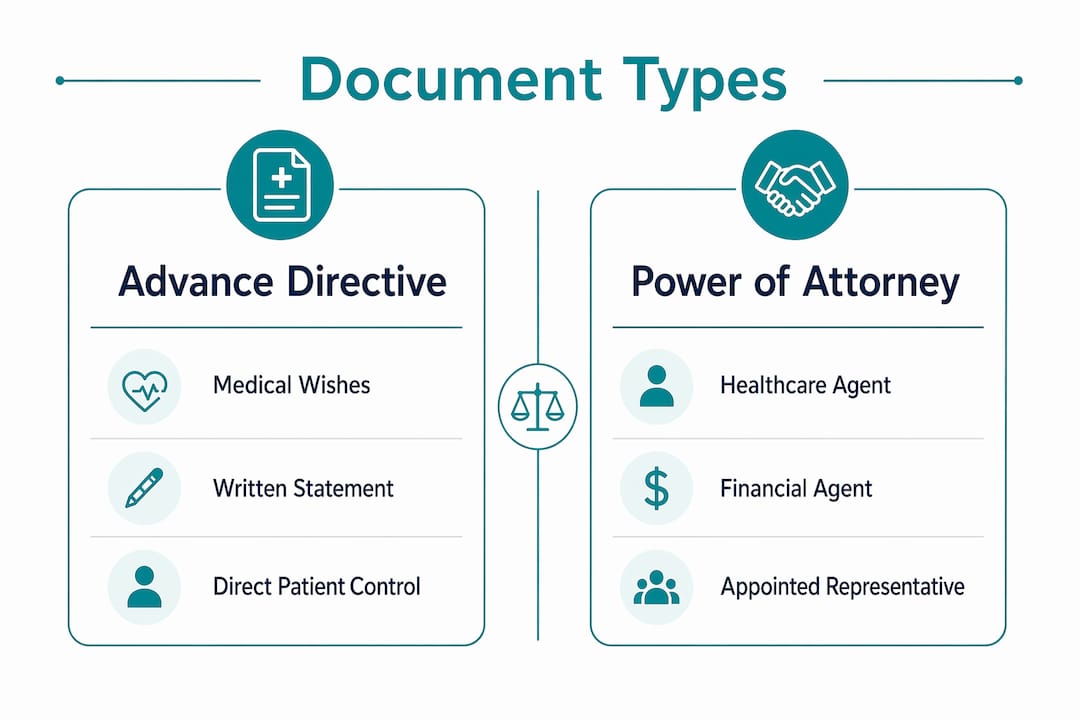
An advance directive is a written statement of your medical treatment preferences. It typically covers decisions about life-sustaining treatment, resuscitation, artificial nutrition, and palliative care. It speaks for you when you are incapacitated and cannot speak for yourself.
A durable power of attorney for healthcare (also called a healthcare proxy) names a specific person to make medical decisions on your behalf. This person is your agent. They interpret your advance directive in real time and advocate for you in situations the document may not have anticipated.
A durable power of attorney for finances covers a separate but equally critical area. It names someone to manage your bank accounts, pay bills, and handle property if you become incapacitated. Without it, your finances can freeze at exactly the moment you need them most. Bills still need to be paid, insurance policies must remain active, and property needs management. A financial power of attorney helps keep daily life functioning while you recover or receive care.
| Document | What it covers | Who acts on it |
|---|---|---|
| Advance directive | Medical treatment preferences | Clinicians and care teams |
| Healthcare POA | Real-time medical decisions | Your named healthcare agent |
| Financial POA | Bank accounts, bills, property | Your named financial agent |
Pro Tip: State-specific forms matter. A document drafted for California may not be recognized in Florida. Use your state's official advance directive form, available through state health departments or organizations like CaringInfo.
One more thing worth knowing. Documents can be updated anytime as long as you can communicate. Your wishes at 55 may look different at 72. Review your documents after any major health change, move to a new state, or shift in your personal relationships.
The risks are concrete, not hypothetical. They play out in hospitals, courtrooms, and care facilities every day.
Without a directive, clinicians default to doing everything possible to sustain life. That may mean ventilators, feeding tubes, and resuscitation attempts you would never have chosen.
Cognitive decline can incapacitate solo agers without a spouse sharing caregiving, risking court guardianship. Guardianship strips you of legal decision-making power and hands it to someone a judge selects.
Hospitals have ethics committees and social workers who step in when no agent is named. They are well-meaning professionals. They do not know your values, priorities, or the life you have built.
Without a financial POA, your accounts may be inaccessible even to people who genuinely want to help you.
Friends or distant relatives placed in an impossible position without guidance carry that weight long after the crisis passes.
"Procrastination is common among solo agers despite the clear benefits of documentation. Many only complete paperwork late or never, which leads to avoidable loss of control during critical moments." — medRxiv advance care planning research
The hardest part is that most people know they need these documents. The gap between knowing and doing is where control slips away.
Personal wish planning for singles requires a clear starting point and a realistic process. Here is a steady, step-by-step approach that works.
Talk to the person you are considering as your healthcare agent before you name them. Confirm they are willing, available, and genuinely understand your values. This conversation is more important than any signature.
Institutions will not recognize verbal wishes or informal notes. Formal, legally executed documents are required to confer authority on healthcare agents and financial proxies. Find your state's official forms through your state health department or a licensed elder law attorney.
Write a brief personal statement alongside your advance directive explaining why you hold certain preferences. Your agent will face decisions your form never anticipated. Values give them a compass.
Give signed copies to your healthcare agent, your primary care physician, and any specialist managing a chronic condition. Keep one in a clearly labeled folder at home. Consider a living alone emergency plan that tells first responders where your documents are located.
Create a secure list of important accounts and contacts. While passwords should be protected, your healthcare agent or financial representative should know how to locate critical information if an emergency occurs. This is increasingly important for solo agers managing healthcare decision planning independently.
A new diagnosis, a move to a different state, or a change in your relationship with your named agent all warrant a review. Documents can be updated anytime when you are capable of communicating.
A life care plan for solo agers goes beyond legal documents to map out your housing preferences, daily support needs, and care priorities. It gives your agent context that a standard advance directive cannot provide.
Pro Tip: If you are aging without children, consider working with a professional fiduciary or a geriatric care manager as your named agent. These are licensed professionals trained to act in your best interest without the emotional complications that can arise with friends or distant family.
The benefits of personal wish documentation extend beyond medical emergencies. They give you clarity today. Knowing your plan is in place reduces anxiety and lets you focus on living well, not just preparing for the worst.
Solo agers who document personal wishes retain control over healthcare, finances, and end-of-life decisions that would otherwise fall to courts, institutions, or uninformed strangers.
| Point | Details |
|---|---|
| Documentation protects independence | Advance directives and POAs prevent courts from appointing strangers to make your decisions. |
| Both documents are required | An advance directive and a healthcare POA work together; neither alone provides full protection. |
| Nearly 1 in 3 adults 50+ lack documentation | This gap leaves solo agers especially vulnerable to unwanted treatment and legal delays. |
| State-specific forms are legally required | Informal notes and verbal wishes are not recognized by hospitals or financial institutions. |
| Regular review keeps documents current | Update your documents after any health change, relocation, or shift in personal relationships. |
| Planning reduces stress | Having documents in place provides peace of mind and reduces uncertainty for both you and those who may help you. |
I have seen the same pattern repeat itself. Someone in their 60s or 70s, sharp and capable, puts off completing their advance directive because it feels like tempting fate. They tell themselves they will get to it. Then a health event happens, and suddenly the window for making those decisions has closed.
What strikes me most is that the emotional resistance is understandable. Filling out a form that asks what you want done if you stop breathing is not a comfortable afternoon activity. But the discomfort of the form is nothing compared to the discomfort of losing control entirely.
The solo aging experience carries a particular kind of quiet weight. You have built your independence deliberately. You have made your own decisions for years, maybe decades. Documenting your wishes is not an admission of vulnerability. It is the most direct expression of that same independence applied to the future.
What I have also noticed is that the people who complete this process early report something unexpected: relief. Not dread, not sadness. Relief. The plan is in place. The right people know what to do. That is not a small thing. That is peace of mind backed by legal authority.
If you are aging without children, the stakes are even higher. A guide to aging without children can help you think through who belongs in your support circle and how to formalize those relationships before you need them.
Build the plan now, while the choices are entirely yours to make.
— Mike
Agingsolo is built specifically for people in your position. The guides, checklists, and planning tools on the site address the real gaps that solo agers face, including healthcare proxies, life care planning, and emergency readiness.
If you are not sure where to begin, the free planning resources on Agingsolo give you a structured starting point without overwhelming you. For those aging without children, the dedicated guide on why childless aging requires earlier planning explains exactly why timing matters and what to prioritize first.
You can also explore healthcare proxy guidance to understand how to choose and prepare the right person to speak for you. These tools are designed to move you from awareness to action, one clear step at a time.
Explore free planning resources, checklists, and guides built specifically for solo agers. Take the first step today.