

A solo aging binder is a centralized set of documents organizing your critical personal, medical, financial, and legal information so that you and anyone helping you can find what matters fast. Think of it as your personal command center for independent living. Whether you call it a care binder, an emergency binder, or an aging binder for seniors, the purpose is the same: make sure the right information is in the right hands at the right moment. For adults living alone without a nearby spouse, partner, or adult children, this kind of preparation is not optional. It is the foundation of a real safety net.
According to AARP, millions of Americans are aging without a spouse, partner, or nearby adult children available to help manage emergencies and major life decisions. For many solo agers, a well-organized binder becomes one of the simplest and most effective planning tools available.
Solo Aging Binder Checklist
A good solo aging binder should contain information that someone could quickly locate during an emergency or unexpected health event.
- Emergency Contacts
- Medication List
- Allergies
- Primary Care Physician
- Specialist Contacts
- Insurance Information
- Health Care Proxy
- Durable Power of Attorney
- Living Will
- Financial Overview
- Home Information
- Support Circle Contacts
- Personal Wishes
- Monthly Review Date
You do not need to complete everything in one day. Start with one section and build your binder over time.
What is a solo aging binder and what goes inside?
A solo aging binder is the practical answer to one of the most common risks solo agers face: nobody knows where anything is when something goes wrong. The binder solves that problem by pulling everything into one place.
The standard contents fall into a few clear categories:
- Emergency contacts and plan: Names, phone numbers, and roles for your doctor, attorney, trusted neighbor, and designated agent
- Medical snapshot: Current conditions, medications with dosages, allergies, and primary care and specialist contacts
- Insurance information: Health, dental, vision, Medicare or Medicaid cards, and long-term care policy details
- Financial overview: Bank names, account types, and contact numbers (not full account numbers for security)
- Legal documents: Health care proxy, medical power of attorney, durable power of attorney, and advance directives such as a living will or POLST form
- Property and home details: Mortgage or lease info, utility contacts, home security instructions, and spare key location
- Daily care routines: Medication schedules, dietary needs, and any regular appointments
A well-designed binder is portable and immediately usable in emergencies, allowing authorized people to find key information in under two minutes. That speed matters when a paramedic or neighbor is standing in your living room.
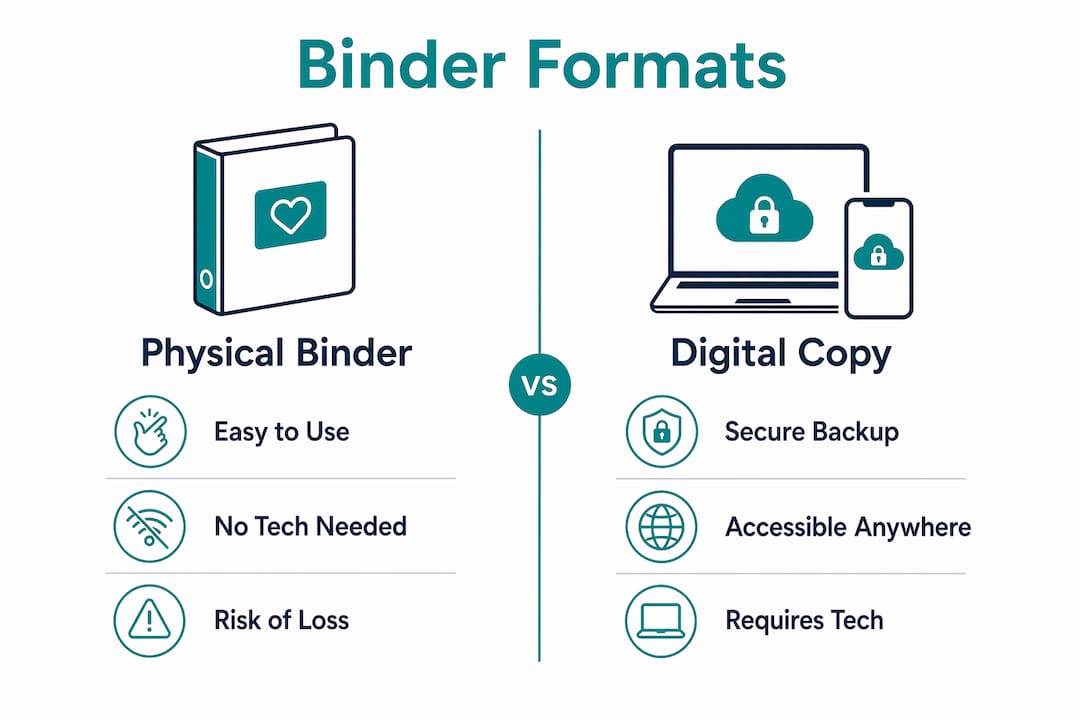
Choosing your format matters too. Here is a quick comparison:
| Format | Pros | Cons |
|---|---|---|
| Physical binder | Easy to hand over, no tech required | Can be lost, damaged, or outdated |
| Digital binder | Easy to update, shareable remotely | Requires device access and passwords |
| Hybrid (both) | Covers all scenarios | Requires maintaining two versions |
Most solo agers do best with a hybrid approach. Keep a physical binder at home and a secure digital copy in a service like Google Drive or a password manager your trusted contact can access.
Digital files are useful only if someone can access them. If your trusted contact does not know where your files are stored, what platform you use, or how to retrieve them during an emergency, a digital binder may be difficult to use when time matters most. For that reason, many solo agers choose a hybrid approach: a physical binder supported by digital backups.
Pro Tip
Place a one-page master instructions sheet at the very front of your binder. Label it clearly. It should tell any helper who to call first, where the legal documents are, and what each section contains. This single page prevents confusion when someone is stressed and searching.
Already know you need one?
We built it for you. The Aging Solo My Plan Notebook is a print-and-write companion with six tabbed sections, a front-page emergency summary, and dedicated space for medications, doctors, emergency contacts, insurance information, important documents, and personal wishes. Rather than creating a binder from scratch, you can print it, fill it in, and keep everything in one place.
Get it hereWhy does a solo aging binder matter for independent living?
The solo aging binder purpose goes beyond organization. It is a tool that protects your right to make your own decisions, even when you cannot speak for yourself.
Legal documents with designated authority are critical when no family is immediately available. Without them, medical staff and courts may make decisions for you that do not reflect your wishes. A binder that includes a signed medical power of attorney and advance directive removes that risk.
A solo aging binder does not just organize paper. It communicates your intentions to the people who need to act on your behalf, clearly and without delay.
The practical benefits stack up quickly:
- Emergency responders get your medication list and allergy information immediately
- Your designated agent knows exactly what authority they have and where the documents are
- You avoid court-ordered guardianship, which can strip you of control over your own life
- Neighbors and trusted friends can assist without overstepping their role
- You gain genuine peace of mind knowing the plan exists and works
Solo agers need specific paperwork and advance planning for both financial and health decisions because social support alone is not enough. A neighbor who cares about you cannot authorize medical treatment without the right legal document in hand. The binder makes sure that document is findable and usable when it counts.
For a deeper look at emergency preparedness for adults living alone, Agingsolo has a full practical guide built specifically for this situation.
How do you create and maintain a solo aging binder?
Building your binder does not have to happen in one afternoon. A steady, step-by-step approach works better and sticks longer.
-
1
Gather your documents first. Pull together what you already have: insurance cards, medication bottles, your will, any existing power of attorney forms. Do not worry about gaps yet.
-
2
Organize into labeled sections. Use tabbed dividers for each category: Emergency Contacts, Medical, Insurance, Finances, Legal, Home, and Daily Routines.
-
3
Fill the gaps. Identify what is missing. If you do not have a health care proxy or durable power of attorney, contact an elder law attorney. Agingsolo's guide on documenting personal wishes walks through exactly what these documents cover.
-
4
Choose your format. Decide whether you want physical, digital, or hybrid. Set up your digital copy with a secure, shared folder your trusted contact can access.
-
5
Write your master instructions page. This goes at the front. It names your key contacts, explains each section briefly, and clarifies who has legal authority to do what.
-
6
Share copies with the right people. Your designated agent should have a full copy. Your attorney should hold originals of legal documents. A trusted neighbor may only need the emergency contacts page.
Keeping the binder centralized, simple, and ready to hand over reduces stress and improves care coordination during emergencies. The goal is not a perfect filing system. The goal is a binder someone else can use without calling you for instructions.
Maintenance is where most people fall short. Regularly updating the binder after life events keeps medication lists and provider contacts accurate. Set a calendar reminder for the first of every month to review one section. After any hospitalization, medication change, or move, update the relevant pages immediately.
Pro Tip
Tape a small sticky note to the front cover with the date you last reviewed the binder. It takes five seconds and tells any helper how current the information is.
Common pitfalls to avoid:
- Storing the binder somewhere so "safe" that nobody can find it
- Forgetting to update medications after a doctor's visit
- Mixing legal authority documents with general information without clear labels
- Never telling your trusted contacts the binder exists
How does a solo aging binder fit into your bigger plan?
The binder is one piece of a larger picture. The solo aging binder works best as part of an interconnected system that covers health, housing, finances, people, and legal authority together. Each area affects the others.
Think of the binder as the interface between you and everyone who might help you. It does not replace a life care plan, a support circle, or a housing strategy. It connects all of those things so helpers can act on your behalf without guessing.
Here is how the binder fits within the broader solo aging planning framework:
| Planning Area | What It Covers | Binder's Role |
|---|---|---|
| Health | Conditions, medications, providers | Medical snapshot section |
| Legal | POA, health care proxy, advance directives | Legal documents section |
| Finances | Accounts, insurance, benefits | Financial overview section |
| Housing | Lease, utilities, home safety | Property and home section |
| People | Trusted contacts, support circle | Emergency contacts section |
Separating informational documents from legal authority documents prevents the common failure where helpers do not know what they are allowed to do. A neighbor can call 911. Only your designated agent with a signed power of attorney can authorize a medical procedure or access your bank account. Your binder should make that distinction obvious.
Aging in place is the goal for most solo agers. The binder directly supports that goal by making your home situation manageable for helpers without requiring them to move you somewhere else. Agingsolo's aging in place guide covers the full picture of staying safe and independent at home.
Key takeaways
A solo aging binder is the single most practical tool a solo ager can build to protect independence, communicate intentions, and prepare trusted contacts to act without confusion.
| Point | Details |
|---|---|
| Core definition | A solo aging binder centralizes medical, legal, financial, and contact information in one accessible place. |
| Legal documents matter most | A signed health care proxy and power of attorney give your agent the authority to act when you cannot speak. |
| Maintenance is non-negotiable | Review monthly and update immediately after any medication change, hospitalization, or life event. |
| Share it with the right people | Your designated agent needs a full copy; trusted neighbors may only need the emergency contacts page. |
| Binder fits a bigger system | It works best alongside a life care plan, support circle, and housing strategy, not as a standalone fix. |
The binder is only as good as your commitment to it
I have seen people spend a weekend building a thorough, well-organized binder and then never touch it again. Two years later, the medications listed are wrong, the doctor listed retired, and the phone number for the emergency contact changed. That binder does not help anyone. It creates false confidence.
The real value of a solo aging binder is not the act of creating it. It is the habit of maintaining it. Treating it as a living document changes everything. When you update it after every doctor's visit or life change, it becomes genuinely reliable. Helpers trust it. You trust it. That trust is what makes independence sustainable.
The other challenge I hear about often is knowing who to share it with. Many solo agers feel uncomfortable handing over personal information, even to people they trust. That discomfort is worth pushing through. You do not have to share everything with everyone. Give your designated agent the full picture. Give a trusted neighbor just enough to help in an immediate emergency. The master instructions page at the front of your binder can spell out exactly who gets what.
One more thing: do not let the size of the task stop you from starting. A binder with your emergency contacts, medication list, and one signed legal document is already more than most solo agers have. Build from there.
— Mike